One of the most popular wine regions at The Little Fine Wine Company is Bordeaux, with staff and customers alike!
The name ‘Bordeaux’ is seen as a byword for high-quality red wines made primarily from Merlot and Cabernet Sauvignon (although, as we will learn, there’s more to modern red Bordeaux than just this classic duo) as well as white blends of Sauvignon Blanc and Semillon, the legendary sweet wines of Sauternes, and even a little bit of sparkling Cremant.
It’s a region which boasts centuries of winemaking heritage, but it would be a mistake to view Bordeaux as out of date, or behind the times; in fact, at whatever end of the price spectrum, there has probably never been a more exciting time to be a Bordeaux lover…
Where is Bordeaux?
If you have visited the region, you’ll know that the city of Bordeaux lies on the Garonne river, which joins with the Dordogne to form the wide Gironde estuary running north-west to the Atlantic Ocean. It’s a short flight from the UK, a train from Paris or a relatively easy ferry/drive combination, just in case you are looking for summer holiday ideas!
In vineyard terms, however, these rivers divide the region into the famous Left Bank area (west of the Garonne and Gironde) and Right Bank (east of the Dordogne), with the Entre-Deux-Mers region (literally meaning ‘between two seas’) lying in the middle.
Bordeaux is one of the largest fine wine regions in the world (and the largest in France), with approximately 90,000 hectares under vine and several thousand producers. This has actually reduced in size over the last four years (by around 10,000 hectares no less, in line with lower wine consumption with some of Bordeaux’s markets). However, the region still produces hundreds of millions of bottles a year, meaning it can be slightly daunting knowing which to choose! Red wine production takes the lead with just over 80% of its total production, followed by dry whites (about 10%), delicious sweet wines, rose and sparkling Cremant de Bordeaux.
A brief history
Vines were first planted around Bordeaux by the Romans in the first century AD. After the Fall of Rome, the surviving vines were tended by monks until the 1100s, when the region’s fortunes were transformed, as Eleanor of Aquitaine married Henry II of England in 1152, and exports took off. It was all the way back in 1199 that the commune of St-Emilion was founded, making it the first and oldest of Bordeaux’s famous regions.
In more recent history, Bordeaux as we know it today really began to take shape with the creation of the 1855 Classification system, which led to increased focus on quality. However, winemaking here nearly met its end in the late 1900s as the phylloxera mite ravaged the Bordelaise vineyards; by 1900, around two thirds of all the vines in France had been wiped out by this microscopic pest. Fortunately, innovations in viticulture enabled replanting with phylloxera-resistant rootstock, and slowly but surely, Bordeaux recovered and began to thrive … taking us through to the present day.
What is the terroir like?
Bordeaux, like all great wine regions, would not have achieved the reputation it enjoys today if not for the combination of environmental factors (the terroir) that make this a great place to grow wine grapes.
The region has a maritime climate where extremes of weather are moderated by the Atlantic, the Gironde estuary and the Garonne and Dordogne Rivers, as well as the pine forests nearby which provide shelter against ocean breezes. In a maritime climate, winters are mild and summers warm, although any rain at flowering or harvest increases chances of vintage variation, and is the reason why the blend of grapes change from year-on-year. In some years, Merlot will do better, and others Cabernet Sauvignon, so the blend changes accordingly…
In terms of soils, they vary hugely, particularly in the large Entre-deux-Mers region which has clay, climestone, sandy and alluvial soils closer to the river.
The Left Bank of Bordeaux comprises the areas known as the Medoc and Graves; they are famous for deep gravel soils left behind by the rivers over millennia. They drain well and retain heat, ideal for late-ripening Cabernet Sauvignon.
On the Right Bank (ie Saint Emilion, Pomerol and neighbouring vineyard appellations) clay and limestone soils dominate. Merlot loves clay, particularly in Pomerol, where an iron-rich subsoil known locally as “crasse de fer” gives wines their richness and power. Saint-Emilion has clay alongside limestone, particularly on the high plateau and slopes around the old town.
Wine styles
But we should turn to the real superstars of Bordeaux – the grapes themselves… As we’ve mentioned, the region’s most famous names are Cabernet Sauvignon and Merlot, which thrive best on the Left and Right Banks respectively – although it’s important to note that this is by no means a hard and fast rule, and you’ll find plenty of both on each side of the river. The strength of Bordeaux is in the blend, after all! Cab Sauv and Merlot are the traditional foundations of red Bordeaux, supplemented by other varieties such as Cabernet Franc, a perfumed grape adding freshness and a leafy berry edge; Petit Verdot which is typically a small percentage of the blend, adding colour, spice and power; and Malbec and Carmenere which are both rare today but historically was apart of the blend. They combine to create, at their best, those subtle yet opulent bottles with rich fruit and beautiful tertiary complexity – think ripe blackcurrants, pencil lead and plum in youth, and cigar, forest floor, tobacco and cedar notes as the wines age.
As mentioned earlier Cabernet Sauvignon thrives in the Left Bank, creating structure wines with blackcurrant, cedar and graphite notes, which are perfect for long ageing. Whereas on the Right Bank in Saint Emilion and Pomerol the blends are Merlot-led which are plusher and rounder with plum, chocolate and truffle.
Many top estates now farm organically or biodynamically, and sorting tables (to ensure the best quality grapes are used) and gravity-fed cellars are commonplace. While some of the more humble wines of Bordeaux are made without the influence of oak barrel ageing, most wines capable of mid and long-term ageing spend 12-24 months in French oak barriques, with the proportion of new oak varying by wine producer. This does vary however, and the ‘second wines’ of each estate (typically those made from younger grapevines, not usually used for the flagship wine, known as the ’Grand Vin’) are usually aged for 12-18 months, with fewer new oak barrels used.
Appellations such as Bordeaux Superieur, Cotes de Bordeaux, Castillon and Fronsac offer excellent drinking for modest sums, while Cru Bourgeois estates in the Medoc deliver much of the character of the classed growths at a fraction of the price. For collectors, the classed growths and top Right Bank names are serious investment-grade wines.
Red is not the only colour in Bordeaux, though. The region’s white wines are garnering increasing acclaim, with blends of Sauvignon Blanc and Sémillon that can be bright and fresh, or offer some serious class and weight when treated to oak barrel age or longer time spent gaining flavour and texture on the fermentation lees.
No discussion of the greats would be complete without a nod to Sauternes, perhaps the greatest of all sweet wines. Sauternes is so successful thanks to the early morning mists which roll off the Garonne and facilitate the development of noble rot, that famously friendly fungus which shrivels the grapes (mostly Semillon, sometimes with a touch of Sauvignon Blanc and Muscadelle) and creates fruit of intense flavour and concentration. They really are superb dessert-style wines, and are often exceptionally good value!
Lesser-known styles include Bordeaux roses and the sparkling Cremant. There is also a resurgence in the original style of ‘claret’ which resembles a lighter-coloured, fresher style of red wine from this region. The lighter ‘Claret’ definition of Bordeaux red wines was enshrined in law from the 2025 vintage. This means that the term ‘Claret’ will no longer be used as a generic term for all red Bordeaux (as happened in much of the UK), and instead will help differentiate the lighter style from the richer, more tannic style that is associated with the top wines of Bordeaux.
Visitng Bordeaux
It would be wrong to conclude without spending a little more time on the many and varied delights that Bordeaux has to offer outside of the vineyards. The city of Bordeaux itself has become increasingly cosmopolitan in recent years, with an explosion of fantastic restaurants, bars, and boutique hotels – any trip to the region is not complete without a night or two spent enjoying this friendly, attractive and welcoming city, where wine lovers are welcomed with open arms!
The city of Bordeaux is a UNESCO World Heritage site with elegant 18th-century architecture, a lively riverside and excellent food markets. La Cite du Vin, a striking museum dedicated to wine culture, is a must-see.
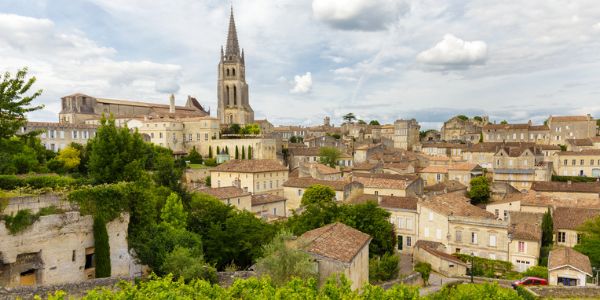
Out in the vineyards, the Route des Chateaux through the Medoc passes some of the most famous estates in the world, many of which welcome visitors by appointment. The medieval town of Saint-Emilion has cobbled streets, underground cellars and its own UNESCO listing.
Further afield, the oyster beds of Arcachon Bay and the vast Dune du Pilat, Europe’s tallest sand dune, make an easy day trip. Don’t leave without trying a canele, the little caramelised pastry that is a Bordeaux signature. If you are wandering the streets of Saint Pierre, go and enjoy this delicious pastry with a glass of Sauternes to satisfy a sweet tooth. The food and wine pairing possibilities really are endless; rest assured that a trip to Bordeaux satisfies lovers of food, wine, and culture alike!
At the Little Fine Wine Company, we pride ourselves on offering a carefully curated selection of Bordeaux wine in smaller formats, perfect for both tasting and convenience. Our range includes outstanding examples from across the region, from silky Right Bank Merlots to structured Left Bank blends. Whether you’re a seasoned enthusiast or new to Bordeaux, you’ll find plenty of wines that showcase the region’s elegance, cellarability, food-friendliness and delicious flavour. Cheers, or ‘sante!’ we should say!